
Put a stone lantern in the middle of a sunny lawn and the whole scene falls apart fast. The maple looks stressed, the grass looks thin, and the lantern reads like a prop instead of a garden element.
This combination works best in spaces that already feel contained, shaded, and quiet before you add anything iconic. If the site is hot, exposed, and visually busy, forcing this look usually costs more than it gives back.
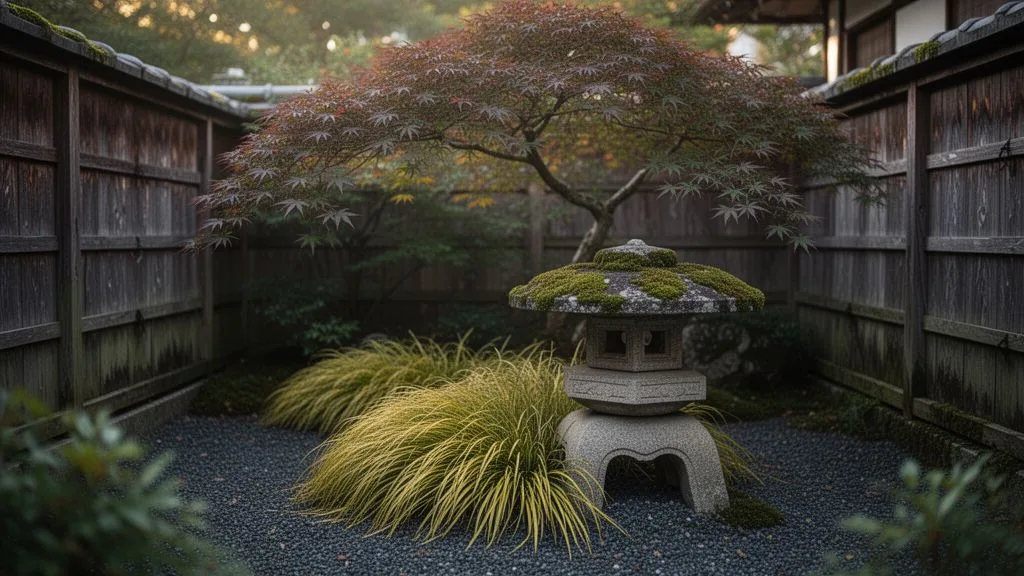
The good version is restrained. A single Acer palmatum sets the canopy, a broad drift of Hakonechloa macra softens the ground, and one lantern gives the eye a pause point. Nothing needs to perform like stage decor.
Small enclosed gardens carry this look better than open yards
A side yard, entry court, or narrow patio edge is usually a stronger match than a wide backyard. In a space 8-by-12 feet or even 10-by-16 feet, every element has enough visual weight to matter. The maple creates overhead structure, the grass reads as a real mass, and the lantern feels tied to movement through the space.
Enclosure does part of the design work for you. Brick walls, timber fencing, hedges, or even the side of a garage can compress the view and make details feel intentional. I have seen simple urban courtyards in Portland look more convincing with one good tree and gravel than larger suburban lots packed with expensive ornaments.
Here is the contrarian point: bigger is often worse. This palette gains strength from limited sightlines, not from extra square footage.
Light matters more than style references
Filtered morning sun with protection after noon is the sweet spot. Roughly 4 to 6 hours of gentle direct light is enough for good foliage density without inviting scorch. East-facing exposures are easier than west-facing beds, especially near reflective paving.
Not all maples behave the same. Acer palmatum 'Bloodgood' can take more sun than many finely cut laceleaf forms, while 'Seiryu' is admired for its texture but can look rough quickly in hot wind. For the grass, Hakonechloa macra 'Aureola' glows in bright shade, but harsh afternoon exposure can crisp the leaf edges by July.
Deep shade is not a fix. Too little light makes the planting weak, and then the lantern becomes oddly dominant.
Soil and moisture decide whether the planting looks lush or tired
This is a foliage-driven composition, so survival is not enough. The bed needs to stay evenly moist while still draining well after rain. If winter water sits around roots, maples sulk. If the soil swings from soggy to bone dry, Hakone grass loses its soft, cascading form.
Start with bed preparation, not accessories. Improve the top 12 inches with compost, leaf mold, or fine bark if the native soil is compacted builder clay. A 2- to 3-inch mulch layer helps regulate temperature and reduces surface drying in summer.
Ground treatment around the lantern matters too. Bare dirt is harsh. A simple ring of crushed gravel about 24 inches across can make even a modest lantern placement feel deliberate.
A practical planting layout that usually works
For a compact courtyard, use one maple instead of a collection of dwarf curiosities. A 15-gallon tree often establishes more reliably than a large specimen dug from a nursery field and dropped into poor soil. Underplant with 5 to 9 Hakone grass plants on roughly 18-inch centers so they knit into a ribbon rather than isolated tufts.
Then place the lantern off-axis, not centered. Near a bend in a path is good. Slightly screened by foliage is better. The object should be discovered from a window or on approach, not announced from across the yard.
- Cool bright shade: Acer palmatum 'Seiryu', Hakonechloa macra 'Aureola', matte granite lantern, dark gravel, and a few dry-shade ferns.
- Morning sun, protected afternoons: Acer palmatum 'Bloodgood', plain green Hakone grass, black mondo grass, and weathered stepping stones with open gravel joints.
- Tight entry court: one upright maple, one broad grass drift, one lantern near the approach, and no extra statuary competing for attention.
Leave empty space. It is not empty in the design sense.
Stone lantern choice should stay quiet, not collectible
Material quality shows immediately here. A carved granite lantern often costs $400 to $1,500, and the weight, edge softness, and surface weathering usually justify it if the rest of the garden is equally restrained. Cheap resin pieces with bright faux-stone coloring tend to look temporary within one season.
Cast concrete can work. It is the budget compromise I would choose before resin, especially in a smaller courtyard where the object is partly screened by plants. Expect something in the $150 to $350 range for a simple low-profile form.
The trade-off is real: better stone improves authenticity, but if that purchase eats the budget for soil prep, irrigation, and a healthy tree, skip the expensive lantern. Spend money on the living structure first.
Where this idea breaks down fast
Hot inland climates are the hardest match. In Sacramento, inland Southern California, or exposed parts of suburban Atlanta, reflected heat from paving can scorch delicate foliage even with drip irrigation. You may keep the plants alive. You may not keep them graceful.
Wind is another problem and it is often underestimated. Fine maple leaves shred, Hakone grass frays, and the whole composition loses the softness it depends on. Once the planting looks rough from June through August, the lantern starts feeling detached from the garden around it.
Busy mixed borders also fight this look. Knock Out roses, tropical bedding color, shiny glazed pots, and multiple specimen evergreens nearby usually drown out the subtlety that makes this planting work.
Can it work in a sunny front yard?
Usually no.
If the front yard gets strong west sun, heat off the driveway, and steady wind, this trio is working uphill from the start. A protected corner may support a tougher maple cultivar, but the full composition rarely looks calm in that setting. I would choose a dry garden or a simpler modern shade-free planting instead of trying to rescue the wrong idea with extra irrigation.
What maintenance looks like after the first planting season
Hakone grass gets cut back in late winter before new shoots emerge. Maples need close attention through the first two summers, especially during heat spikes above 90°F. Gravel may need raking after leaf drop, and mulch should be topped up before summer if the bed dries quickly.
Do less pruning than you think. Over-tidying makes these spaces look stiff. A little leaf litter under the maple is often better for the soil and more natural visually than scraped-clean mulch.
If the siting is right, maintenance eases after year two. If the siting is wrong, the garden keeps charging interest.
Which element deserves the budget if you cannot do all three?
The maple.
A healthy, well-placed Acer palmatum creates canopy, structure, and seasonal change in a way the lantern never can. Buy the tree, prepare the soil, install irrigation if needed, and let the garden settle for a season. Add the lantern later only if the space still asks for it.
I would make the same call almost every time: in an 8-by-12-foot shaded court, one good maple and a real drift of Hakone grass will look more convincing than a larger yard full of symbolic objects. This style succeeds through editing, and it fails the minute it starts trying to explain itself.