
In a narrow bed, the wrong fork feels oversized almost immediately. You catch the shoulders on timber, bruise nearby roots, and spend more effort recovering your stance than loosening soil.
That is why this choice matters more in a city garden than in a big open plot. A border fork and a digging fork may sit side by side at B&Q or Crocus with nearly identical labels, but they behave very differently once you are working between paving, raised-bed sides, and established plants.
For most gardens under 50 square metres, the better first buy is the border fork. It is narrower, lighter, and easier to place accurately. A digging fork still earns its place for harder renovation work, but it is not the smarter everyday tool for a compact urban layout.
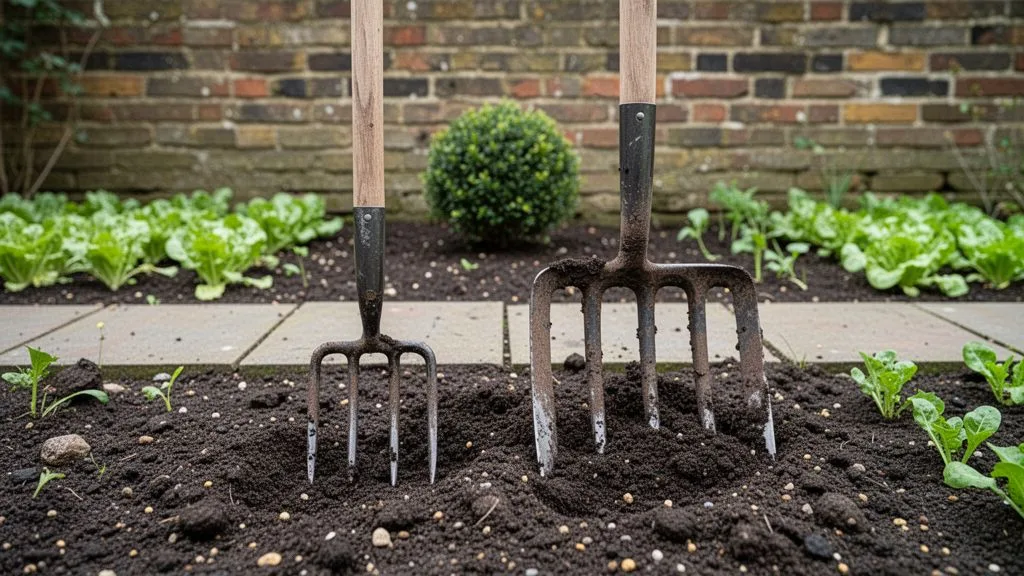
Size changes the job more than the label suggests
The biggest practical difference is head width. A typical digging fork often measures around 18 to 23 cm across. A border fork is usually closer to 14 to 18 cm. On paper, that looks minor. In a 90 cm-wide raised bed, it changes everything.
A wider fork asks for more space at the top of the stroke and more room behind you when levering soil back. A narrower fork slots into tighter gaps and lets you work close to bed edges without the head knocking into boards on every second lift.
Weight matters too. A half-kilo difference is noticeable if you are making short, repeated passes through compost-rich soil or teasing out weeds around perennials. Small gardens encourage stop-start work. You are rarely marching across open ground for an hour straight.
This is the part buyers often miss: smaller does not mean weaker in every real task. It often means more usable.
Why a border fork fits urban beds better
Most urban plots are full of interruptions. There is a fence line on one side, a water butt in the corner, maybe a path of concrete slabs, and a raised bed packed tighter than you first intended. A tool that turns neatly in confined space wins more often than a tool that moves the biggest lump of soil.
The border fork is better around onions, salad rows, strawberries, and compact shrubs because you can place the tines more precisely. That matters if you are loosening a patch between roots rather than emptying the whole bed. It also helps when lifting potatoes or dahlia tubers where a broad fork is more likely to nick what you are trying to save.
In London courtyard gardens and Bristol terraces, bed width is often the real limit, not soil volume. A border fork suits that geometry. It also stores more easily in a cramped shed or bench box, which is not glamorous, but it is real life.
Where the larger fork still has a genuine advantage
A digging fork is better at first-clearance work. If the ground is compacted builder's spoil, sticky clay, or an old patch full of couch grass roots, the wider head lifts more material per pass. That can save time during autumn or winter renovation.
It also helps when incorporating bulk organic matter. If you are turning in several 50-litre bags of compost or a barrow of well-rotted manure, the broader fork covers ground faster.
There is a trade-off. More capacity means less control. In a small planted space, the bigger tool often spends more time being awkward than productive.
So the digging fork is not pointless in a city garden. It is just more specialised than people expect.
Dense clay creates a surprising twist
Heavy soil changes the story, but not in the obvious way. Gardeners often assume the larger fork must penetrate compacted ground more easily. Sometimes it does not.
A narrower border fork concentrates your body weight over a smaller area. In stubborn clay, that can make the first entry easier, especially after rain has passed and the ground is merely damp rather than waterlogged. This is the contrarian bit: the smaller fork can break into hard soil before the larger one will.
Once the tines are in, though, lifting a wet block of clay with a border fork takes more passes and more patience. That is where the digging fork pulls ahead. Penetration and lifting power are not the same thing.
If your soil in places like Manchester or Sheffield is dense and full of rubble, the ideal sequence is often one rough pass with a digging fork followed by more accurate follow-up work with a border fork.
How each fork handles common small-garden tasks
Some jobs clearly favour one tool.
- Raised bed loosening: border fork. Less collision with timber sides.
- Lifting potatoes in a narrow row: border fork. Better control near tubers.
- Aerating around roses or shrubs: border fork. Cleaner placement near roots.
- Opening a new patch of neglected ground: digging fork. Faster soil movement.
- Mixing in bulky manure or compost: digging fork, unless access is very tight.
- Routine maintenance in a 1.2 m by 2.4 m bed: border fork almost every time.
Weekly use matters more than heroic use. In a small garden, the tool that handles ordinary jobs comfortably is usually the right tool to own first.
What to check before buying one
Do not buy on the word border or digging alone. One brand's border fork can feel nearly as large as another brand's compact digging fork. Check the actual head width and total weight.
A D-handle is often easier in confined spaces than a straight T-handle because it gives better control in short levering motions. Four forged tines are standard. Stainless steel stays cleaner and resists rust if the fork lives in a damp shed. Carbon steel often feels tougher in rough ground, but it needs more care.
Bulldog, Spear & Jackson, and Kent & Stowe all make examples in this category. Expect roughly £35 to £80 for a decent full-size fork. Very cheap models can flex at the socket after a season in compacted soil.
Do you need both for a compact plot?
Usually not.
If storage is tight, one full-size fork plus a hand fork is a better pairing than two near-duplicate long-handled tools. In a garden with a couple of raised beds, some containers, and one narrow border, the second fork often becomes dead weight hanging on the wall.
The better combination for most small plots is a border fork and a spade. That covers loosening, lifting, edging, planting, and light renovation with less clutter. Add a digging fork later only if you keep tackling hard ground or take on a larger allotment section.
The best first choice for gardens under 50 square metres
Buy the border fork first.
That recommendation is stronger than it sounds. In compact plots, control matters more than maximum capacity. You are usually working near edges, around roots, inside raised frames, or between crops. The narrower fork suits those conditions better and wastes less motion.
A digging fork still makes sense for repeated heavy clay work or first-time ground clearance. But if you are standing in a garden centre choosing one tool for everyday use, the smaller fork is more likely to leave the shed. In a small urban garden, that is the test that counts.