
A small courtyard can feel awkward fast. The walls trap heat, one corner stays dim all day, and the bright patch you expected to use for flowers only gets about 4 to 6 hours of direct sun. Good news - that is still enough light for a courtyard with structure, color, scent, and even a little food.
The trick is not to copy a full-sun border. Courtyards behave differently from open gardens. Reflected light from brick, stone, or white render can help plants grow better than the raw sun-hours suggest, but tight spaces also dry out quickly in pots and can feel crowded if every idea asks for deep planting beds. Below are 12 ideas that actually suit smaller enclosed spaces, with shade-tolerant or part-sun plants that earn their footprint.
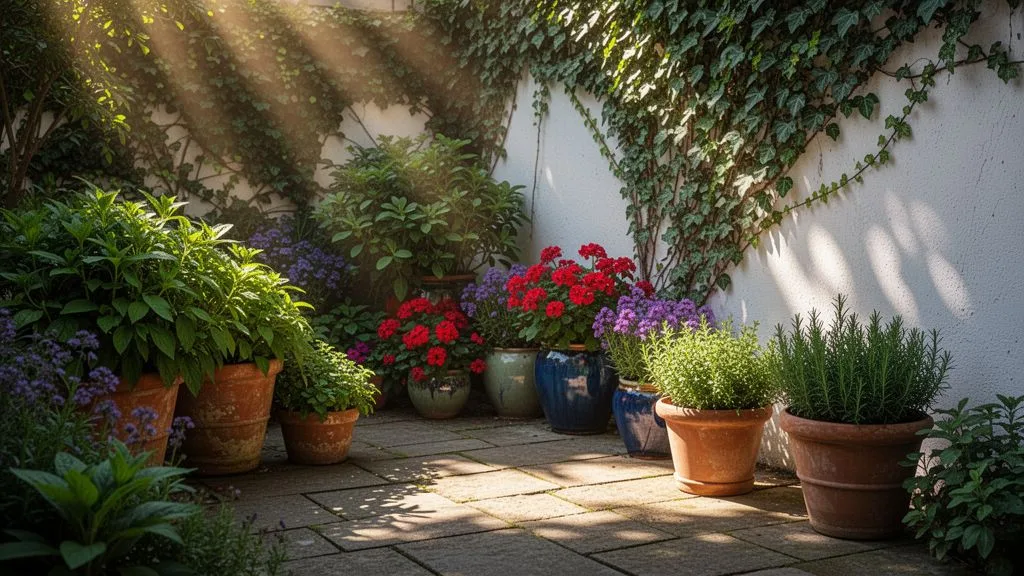
I would choose foliage first and flowers second in a courtyard like this. A small space looks better for longer when the bones are solid.
1. Build the whole scheme around layered foliage in pots
If your courtyard gets only half a day of sun, foliage does a lot of heavy lifting. A mix of heuchera, Japanese forest grass (Hakonechloa macra), hosta, and small ferns creates depth without needing full-day light. This works especially well in London-style brick courtyards or narrow urban patios where flowers can look sparse between flushes.
Use three pot sizes rather than six tiny ones. One large glazed container, one medium terracotta pot, and one low bowl usually look calmer than a scatter of little planters. Aim for repeating leaf shapes: broad hosta leaves, finer fern fronds, and a trailing edge such as ivy or creeping Jenny.
The trade-off is slug damage, especially on hostas. If slugs are a constant issue, swap hosta for heuchera or carex.
2. Use a single small tree to make the courtyard feel finished
One carefully chosen tree can anchor the space better than a dozen small plants. For 6 hours of sun or less, try Acer palmatum, Amelanchier, or a trained olive if the courtyard is warm and sheltered. A Japanese maple is often the safer bet because it tolerates bright shade and gives strong spring and autumn interest.
Go for a multi-stem form in a container at least 45 to 60 cm wide. Underplant it with hellebores or low ferns, and the whole courtyard starts to feel intentional instead of pieced together. This is a strong move in very small spaces because it gives the eye one thing to land on.
Not every courtyard should have a tree, though. If the space is under 2.5 meters wide, a tree can start stealing breathing room unless the canopy is light and lifted.
3. Plant a shady herb corner instead of forcing tomatoes to struggle
This is the non-obvious choice, but it is often the better one. Gardeners sometimes try to grow tomatoes, peppers, or basil in a courtyard that only gets 4 to 5 hours of sun, then wonder why everything stays leggy. In part sun, herbs like mint, parsley, chervil, coriander, and lemon balm usually give better results.
A slim trough on a bench or wall shelf can hold several herbs at once. Parsley and chives are especially reliable. Mint is easy too, but keep it in its own pot unless you enjoy a takeover.
If you want one edible with flowers, alpine strawberries are a better gamble than beefsteak tomatoes here. They tolerate partial sun and fit the scale of a courtyard.
4. Turn one wall into a vertical planting surface
Courtyards rarely lack walls. They lack ground. A vertical system lets you garden without eating into floor space, and it also softens hard boundaries that can make enclosed spaces feel stark. Wall planters, stacked pocket systems, or a simple metal grid with hanging pots can all work.
Choose plants that will not collapse if the top row gets more sun than the bottom. Good candidates include trailing ivy, heuchera, small ferns, ajuga, and compact begonias. If the wall is especially bright from reflected light, add calibrachoa or bacopa in the sunniest upper pockets.
The catch is watering. Vertical planters dry out faster than regular containers, especially in summer. A drip line on a timer, even a basic one from Gardena, saves a lot of frustration.
5. Grow climbers that cope with part sun and make the walls work harder
A courtyard wall should be doing something. If it is just sitting there bare, you are missing one of the best planting opportunities in the whole space. Climbing hydrangea, star jasmine, clematis viticella, and ivy all suit lower-light courtyards, though each behaves differently.
For fragrance, star jasmine is excellent if the courtyard gets enough warmth and at least a few hours of direct light. For deeper shade, climbing hydrangea is more dependable, but slower to establish. Clematis can thread through a trellis without making the space heavy.
Ivy is the budget option and the quickest cover. It is also the one you may regret if you want a neat, controlled look. Use it only if you are willing to prune hard a few times a year.
6. Make a white-and-green planting palette if the courtyard feels dark
Small enclosed spaces can look gloomy even in summer, especially with dark paving or old brick. White flowers and silvery or lime foliage bounce light around. This is less about style jargon and more about simple visual lift.
Try white begonias, hydrangea paniculata in a large pot, variegated hebe, euphorbia, and pale nicotiana where the brightest patch allows. Add a pale container or gravel mulch to reflect more light upward. The effect is stronger than adding a lot of mixed color.
This approach can drift into looking cold if every plant is white. Add one grounding green, like glossy sarcococca or a deep green fern, so the scheme keeps some weight.
7. Use a bench with built-in planters to save floor space
Courtyards need furniture, but loose chairs and random pots can make a tiny footprint feel blocked. A bench with integrated side planters solves two problems at once. You keep the middle area open and still get a decent amount of planting volume.
This works very well along the longest wall. Plant the containers with evergreen structure such as skimmia, dwarf pittosporum, or carex, then soften with trailing plants at the edge. If the bench is timber, line the planting sections properly so wet compost does not shorten its life.
A width of about 40 cm for the seat and at least 30 cm soil depth for the planter is a practical minimum. Anything shallower limits your choices fast.
8. Add a water bowl or compact fountain for movement and cooling
Hard surfaces can make a courtyard feel still and hot. A shallow water bowl, zinc tub, or small recirculating fountain changes the mood immediately. You do not need room for a pond. Even a bowl 50 cm across can be enough.
In lower light, the surrounding planting often looks fresher beside water. Pair it with mossy textures, ferns, or hostas for a softer look. In sunnier corners, a miniature water lily may work if the bowl gets enough direct light, though 6 hours is about the lower edge.
The maintenance is simple but real. You will need to top it up in warm weather and stop mosquito issues by keeping water moving or changing it often.
9. Plant a long narrow border with repeat plants instead of too much variety
If your courtyard has even a slim in-ground bed, resist the urge to collect one of everything. Repetition makes a small space feel calmer and bigger. Three clumps of the same fern or heuchera usually look better than ten unrelated plants squeezed together.
A good low-light border mix might include hellebores for winter and spring, astrantia for summer, evergreen carex for structure, and a few foxgloves if the light is bright enough. Astrantia is especially useful in part sun and brings a looser cottage feel without demanding full exposure.
This is also easier to maintain. Repeated plants are simpler to prune, feed, and replace.
10. Use scented plants near the door or seating area
Small spaces reward details you can notice up close. Scent carries well in a courtyard, sometimes even better than in an open garden because the walls hold it. Put fragrance where you actually pass by or sit, not at the far end where no one catches it.
For part sun, try sarcococca for winter scent, star jasmine for summer, and sweet box or daphne if the spot is sheltered. A pot of scented pelargonium can work in the brightest patch and gives fragrance from the leaves as much as the flowers.
Daphne smells fantastic but can be fussy in containers. Sarcococca is the steadier performer. If I had to pick one for a small courtyard with mixed light, that would be it.
11. Try a gravel courtyard planting area if drainage is a problem
Not every lower-light courtyard is damp. Some are surprisingly dry because of roof overhangs, surrounding walls, and rain shadow. If pots dry out too fast and the ground drains sharply, a gravel garden strip can work, even with only moderate sun.
Use plants that handle leaner conditions such as euphorbia amygdaloides, stipa in the brighter spots, geranium macrorrhizum, and Santolina where the sun is strongest. This is not the lushest option on the list, but it is practical and clean-looking.
The limitation is softness. Gravel can feel a bit stark in a tiny enclosed space unless you balance it with timber, a bench, or larger leafy pots nearby.
12. Create one seasonal focal pot that changes through the year
If you do not want a full redesign, start here. A single large container by the entrance or opposite the back door can become the thing that marks the seasons. Spring bulbs, summer begonias, autumn heuchera, winter skimmia - one pot can carry a lot of visual weight.
Choose a container big enough to hold moisture, ideally 40 cm wide or more. Small decorative pots look nice for a week and then dry out by lunchtime in July. In a courtyard, bigger usually means easier.
This idea is cheap compared with redoing the whole space. Even a solid frost-proof pot from a garden center can be under £60, and you can refresh the planting in stages rather than all at once.
Which courtyard planting style works best with 6 hours of sun or less?
The best style is usually a foliage-led layout with a few seasonal flowers, not a flower-heavy scheme that needs strong all-day light. Courtyards with part sun often look richer with hostas, ferns, heuchera, skimmia, and one small tree than with lots of sun-loving annuals that never quite perform.
If the space gets close to 6 hours and feels warm because of brick or stone, you can stretch into star jasmine, clematis, begonias, and a few edibles. If it is under 4 hours, lean harder into texture, evergreen structure, and pale containers to keep the space lively. That is the clearer path.
How can you tell if a courtyard gets enough light for part-sun plants?
Watch the direct sun, not just the brightness. Part-sun plants usually want about 3 to 6 hours of actual sun on leaves, ideally in the morning or early afternoon. A phone note over two or three clear days is enough to map the pattern.
Reflected light matters too. A white-painted wall can make a 4-hour courtyard feel brighter than a dark stone one with the same sun count. Still, reflected light does not fully replace direct sun for flowering plants, which is why foliage usually wins in these spaces.
What plants are usually the safest bet for a small enclosed courtyard?
For dependable results, start with heuchera, hellebores, Japanese forest grass, skimmia, sarcococca, ferns, astrantia, and Acer palmatum if you want a small tree. Those are easier to fit into mixed light than plants that demand open exposure.
If you want climbers, climbing hydrangea and star jasmine are strong choices depending on warmth and light. For food, parsley and alpine strawberries are more realistic than tomatoes in a courtyard with limited sun. Better to work with the site than fight it for two disappointing harvests.
Do small courtyards with limited sun need more watering or less?
Often more, especially in containers. This catches people out. Less sun does not always mean moist soil, because walls and paving create heat, and rain may not reach pots tucked under eaves or overhangs.
Check moisture with a finger 5 cm down rather than guessing from the surface. Large pots, mulching, and grouped containers help a lot. If you install only one upgrade, make it irrigation for the pots or vertical planters that dry out fastest.
The easiest mistake is chasing a Mediterranean look in a courtyard that behaves more like light shade. Start with one tree or one focal pot, repeat a few reliable plants, and let the walls do some of the visual work. A small courtyard with 4 to 6 hours of sun can look better than a bigger garden that tries to be everything at once.