
Cucumber beetles can wreck seedlings fast. A healthy young cucumber can go from clean leaves to ragged holes and wilt risk in just a few warm days, especially once striped cucumber beetles start feeding and spreading bacterial wilt.
If the goal is protecting young cucumbers, row cover beats neem oil. It works earlier, blocks feeding before damage starts, and does not rely on repeated spray timing. Neem oil still has a place, but mostly as a backup tool or for older plants after covers come off.
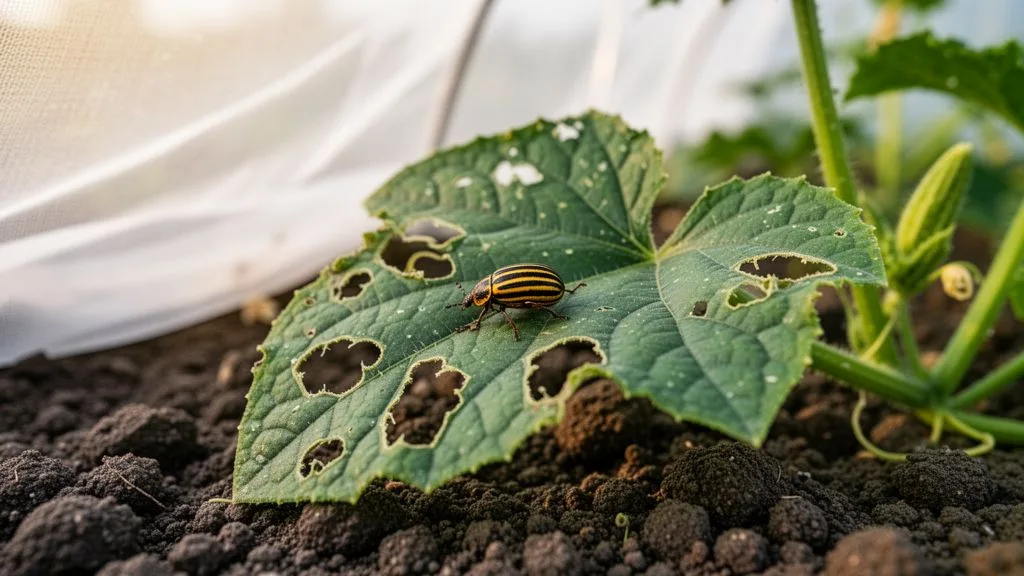
The real split is simple: row cover is preventive, while neem oil is reactive. Young cucumbers usually need prevention more than treatment.
Why row cover protects seedlings better than neem oil
Floating row cover creates a physical barrier. Beetles cannot land, chew cotyledons, scar stems, or spread disease if they never reach the plant. That matters most during the first 2 to 4 weeks after transplanting or emergence, when cucumbers are small and damage adds up quickly.
Neem oil, usually labeled as clarified hydrophobic extract of neem oil or with the active compound azadirachtin, does not make that same barrier. It can reduce feeding, disrupt insect behavior, and help suppress soft-bodied pests, but cucumber beetles are mobile, hard-shelled, and often not controlled well enough by neem alone. A beetle can still land, nibble, and leave behind trouble before the spray does much.
This is the non-obvious part: even modest feeding matters less than the disease vector problem. Striped cucumber beetles are notorious for carrying bacterial wilt caused by Erwinia tracheiphila. A method that prevents contact is stronger than a method that merely irritates the pest after contact.
For young cucumbers, that difference is huge.
How row cover works in a cucumber bed, and where it can fail
Use a lightweight spunbond fabric, often around 0.5 oz per square yard, over hoops or directly over the bed with edges buried or pinned tightly. The seal matters. A small gap at one edge is enough for beetles to crawl in, and once trapped inside, they can feed freely in a protected little tunnel you accidentally built for them.
Row cover works best if it goes on immediately after sowing or transplanting. Waiting until feeding shows up means beetles may already be inside. In a place like Missouri or southern Illinois, where cucumber beetles arrive early and numbers can spike with warm weather, delay costs you.
There are limits. Cucumbers need pollination once they begin flowering, unless you are growing a parthenocarpic type such as Diva or Tyria in a setup where fruit set does not depend the same way on bee visits. Standard slicers and picklers cannot stay covered forever. Heat can also build under fabric during hot spells, especially if the cover is heavier than needed or plants are already stressed.
- Best stage: from seeding or transplanting until first female flowers open
- Main strength: stops feeding before it starts
- Main weakness: must be removed for pollination on most varieties
- Typical cost: roughly $15 to $35 for a small home-garden cover setup, depending on width and hoops
That trade-off is still favorable. Early protection is where cucumbers are most vulnerable.
What neem oil actually does against cucumber beetles
Neem oil sounds attractive because it is organic, available almost everywhere, and easy to spray with a hand pump bottle. On paper, it offers repellency and feeding disruption. In practice, results on cucumber beetles are uneven.
Part of the problem is contact. Beetles move in and out of the patch, hide under leaves, and often feed during windows when residues are less fresh. Neem also breaks down fairly quickly in sun and heat, so one spray is not a lasting shield. If you are applying every 5 to 7 days, and again after rain, you are already in a maintenance cycle.
Another limitation is crop sensitivity and timing. Spraying in direct sun can stress leaves. Spraying open flowers can interfere with pollinators if done carelessly, even with organic products. Evening application helps, but by then beetles may have fed all day.
Neem can still help in a support role. It may slightly reduce feeding pressure after covers come off, and it can be useful if aphids or squash bug nymphs are also present. But for cucumber beetles on very young plants, neem often arrives a step late.
Where neem oil fits after row covers come off
Once flowering starts, the row cover usually has to go. This is where gardeners often feel exposed, and neem becomes tempting again. Used carefully, it can play a limited role in an organic program, but not as the main line of defense.
A better approach after cover removal is to combine close scouting with targeted action. Check plants every day or two for fresh chewing, frass, and beetle counts near blossoms. If pressure is light, hand removal in the cool morning can actually do more than a weak spray routine. Yellow sticky traps can help monitor activity, though they are not enough by themselves to protect a crop.
If you use neem, spray late in the day, avoid open blooms when possible, and follow the label exactly. Clarified neem products and azadirachtin concentrates are not interchangeable in strength or purpose. The spray is a nudge, not a wall.
Which method lowers bacterial wilt risk more effectively
Row cover wins this part clearly. Bacterial wilt is one reason cucumber beetles are more serious than a little cosmetic damage suggests. A single infected striped cucumber beetle can introduce the pathogen while feeding, and once a plant wilts, recovery is unlikely.
Neem oil does not reliably prevent that first bite. It may reduce feeding somewhat, but reducing is not the same as stopping. For disease prevention, the distinction matters more than gardeners sometimes expect.
This is why extension recommendations from land-grant programs such as Iowa State and Purdue commonly lean hard on exclusion and early crop protection. The beetle is not just a leaf-chewer. It is a disease carrier.
Row cover and neem oil side by side in actual garden use
Labor and timing
Row cover takes more setup on day one. Hoops, clips, weights, and sealing edges are a bit fussy. After that, daily effort is low until flowering.
Neem is easier at first. Then it keeps asking for your time. Reapplication after rain, careful mixing, evening sprays, and checking leaf response can turn into a routine fast.
Effect on beneficial insects
Row cover physically excludes pollinators too, which is fine before bloom and a problem during bloom. Neem can affect non-target insects if sprayed directly or if blooms are hit. Neither tool is perfect, but row cover is cleaner during the seedling phase because there are few pollination needs then.
Cost over a season
A decent fabric cover can last more than one season if stored dry and out of sun. Neem bottles are consumable. For one short cucumber row, neem may look cheaper upfront, but repeated use can erase that difference by midsummer.
Performance in wet weather
Rain does not wash off a properly anchored cover. Rain absolutely shortens the life of a spray deposit. This alone shifts the comparison in favor of row cover during unstable spring weather.
A practical recommendation for young cucumbers
Use row cover from planting until flowering starts. Remove it when pollination becomes necessary. After that, scout closely and use neem oil only if pressure rises and you need a modest organic follow-up.
If you have room, add one more trick that beats either method alone: plant a later succession 2 to 3 weeks after the first. Sometimes the second planting escapes the worst early beetle surge, especially in backyard gardens where the first wave concentrates on the earliest cucurbits.
For gardeners choosing just one method for young plants, pick row cover. It is the stronger answer, not just the safer one.
How can you use row cover without causing pollination problems later?
Keep the cover on only through the early vegetative stage. Once you see flowers starting, especially female flowers with the tiny fruit behind the petals, remove the cover so bees can reach the plants. If you are growing a parthenocarpic cucumber in a protected setup, pollination may matter less, but standard garden types still need access.
Can neem oil burn cucumber leaves or harm pollinators?
Yes, it can cause leaf stress if sprayed in hot sun or mixed too strongly. It can also contact bees and other beneficial insects if applied to open flowers or during active foraging. Spray late in the day, avoid blooms as much as possible, and follow the product label rate exactly.
Is it ever smarter to skip neem oil completely for cucumber beetles?
Yes. If row cover protected the plants through their most vulnerable stage and beetle numbers stay low after bloom, neem may add very little. In that case, daily scouting and quick hand removal are often more useful than starting a weak spray program that never quite gets ahead.
That is the real answer here: for young cucumbers, the better organic method is row cover, and neem oil is optional support after the critical window has passed.